
Across oilfield projects in northern Alberta or northeastern British Columbia, it becomes obvious pretty quickly that the ground is almost never working in your favour.
Depending on the circumstances, the ground your crew stands on could be frozen right through one month, saturated with spring runoff the next, or deeply rutted after weeks of heavy equipment traffic, each requiring a different approach to the machinery that runs over it.
frozen right through one monthThis is exactly why diesel-powered 4×4 boom lifts have become the standard for drilling, completions, and facility construction projects throughout Western Canada’s energy sector. They are built for conditions that simply are not predictable.
Remote Oilfield Sites Demand More From Equipment
Oilfield work has never been particularly forgiving. Projects move quickly, weather changes without much warning, and crews are expected to stay productive even when conditions are far from ideal.
With remote well sites, access is also often limited. A lift may need to travel over loose gravel, compacted clay, temporary access roads, or uneven lease pads before it ever reaches the work area. During spring breakup, those surfaces become even more unpredictable as frost leaves the ground and moisture begins to soften the soil.
A standard two-wheel-drive aerial lift simply is not designed for this lack of stability. The limited traction, reduced ground clearance, and lower stability make it much harder to operate safely once the terrain starts working against the machine.
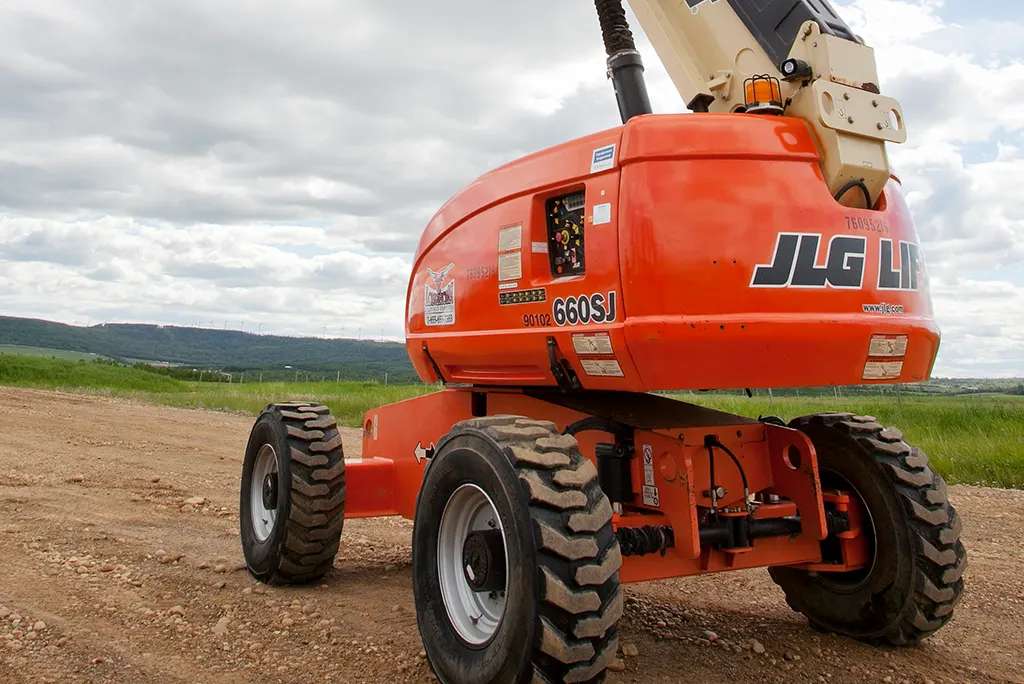
Comparatively, diesel-powered 4×4 boom lifts are engineered to be more effective and efficient in conditions such as these. Their larger tires, higher ground clearance, and four-wheel-drive systems allow crews to reach all sorts of locations that conventional lifts may not be able to get to safely.
Stability Matters More Than Maximum Height
When people compare boom lifts, the conversation often centres on platform height. That is understandable because reaching the work area is obviously important.
In practice, however, stability is usually the bigger concern.
Oilfield crews regularly work around structural steel, processing equipment, pipe racks, production facilities, and elevated mechanical systems where even slight movement can affect both productivity and safety. A machine that feels unstable on uneven ground quickly becomes difficult to work from, regardless of how high it can extend.
Modern rough terrain boom lifts are designed with oscillating axles, wide wheelbases, and sophisticated load management systems that help maintain stability while travelling and while elevated. Those design features allow operators to work with greater confidence, even when the site itself is less than perfect.
Machines in the 60-foot and 85-foot class have become especially common because they provide enough reach for a wide variety of maintenance, construction, and installation work without sacrificing mobility across remote locations.
Diesel Power Makes Sense In Remote Locations
Electric boom lifts have become increasingly common on indoor construction projects and urban job sites, but oilfield work presents a completely different set of priorities.
A major consideration is that you likely won’t have convenient access to electrical infrastructure capable of supporting large battery charging systems. Even where power is available, charging overnight is not practical when operations are frequently scheduled to go around the clock.
Diesel-powered machines eliminate those concerns.
Because most oilfield sites already maintain diesel supplies for generators, heaters, pumps, and heavy equipment, boom lifts naturally fit into existing refuelling routines. Crews do not need separate charging equipment or specialised electrical infrastructure. They simply refuel the lift alongside the rest of the fleet and continue working.
That consistency becomes particularly valuable during extended drilling or facility construction projects where equipment may operate for weeks without leaving the site.
The Right Boom Lift Depends On The Work
Not every project requires the same amount of reach.
For many drilling and completions operations, a 60-foot boom lift provides more than enough working height for equipment installation, maintenance, lighting systems, and elevated inspections. These machines generally offer an excellent balance between reach, manoeuvrability, and transportability.
An 85-foot boom lift allows crews to access taller structures, processing equipment, and elevated steelwork while reducing the need to reposition the machine repeatedly throughout the day.
Manufacturers such as JLG, Genie, and Skyjack have spent decades refining rough terrain boom lifts specifically for tough industrial applications. Their machines can handle uneven surfaces, heavy daily use, and the kind of operating conditions you will find across oilfield projects in northern Alberta and British Columbia.
The best choice is rarely the biggest machine available. It is the machine that provides the safest and most efficient access for the work being performed.
Equipment Reliability Can Influence The Entire Schedule
Mechanical issues can pause a day’s work, especially with replacement equipment hours away. Waiting for repairs means downtime that affects multiple crews, not just the people using the lift.
This is why properly maintained rental equipment is essential in oilfield operations. Thorough inspections, routine servicing, and functional testing reduces the likelihood of unexpected problems in the field and on the job.
Reliable equipment also improves safety. Operators can focus on completing the work rather than wondering whether the machine beneath them is performing as it should.
In an industry where schedules are already influenced by weather, logistics, and changing site conditions, eliminating preventable equipment issues makes a noticeable difference.
Built For The Conditions That Actually Exist
We know that oilfield work in the Montney and Duvernay rarely happens under ideal conditions. Work crews frequently deal with steep lease roads, deep mud, frozen ground, heavy snow, and rapidly changing weather. Their equipment and machinery needs to perform consistently despite those challenges.
That is exactly where diesel-powered 4×4 boom lifts are worth their value. Their combination of traction, stability, reach, and dependable performance allows crews to access elevated work areas safely while keeping projects moving across some of the most demanding terrain in all of Canada.
If your next drilling, completions, or facility construction project needs a dependable rough terrain boom lifts that you can guarantee has been thoroughly inspected, and is field-ready and backed by experienced local support, contact us. Longhorn Oilfield Services can help you choose the right boom lift rental for the job and deliver it to where you need it most.