

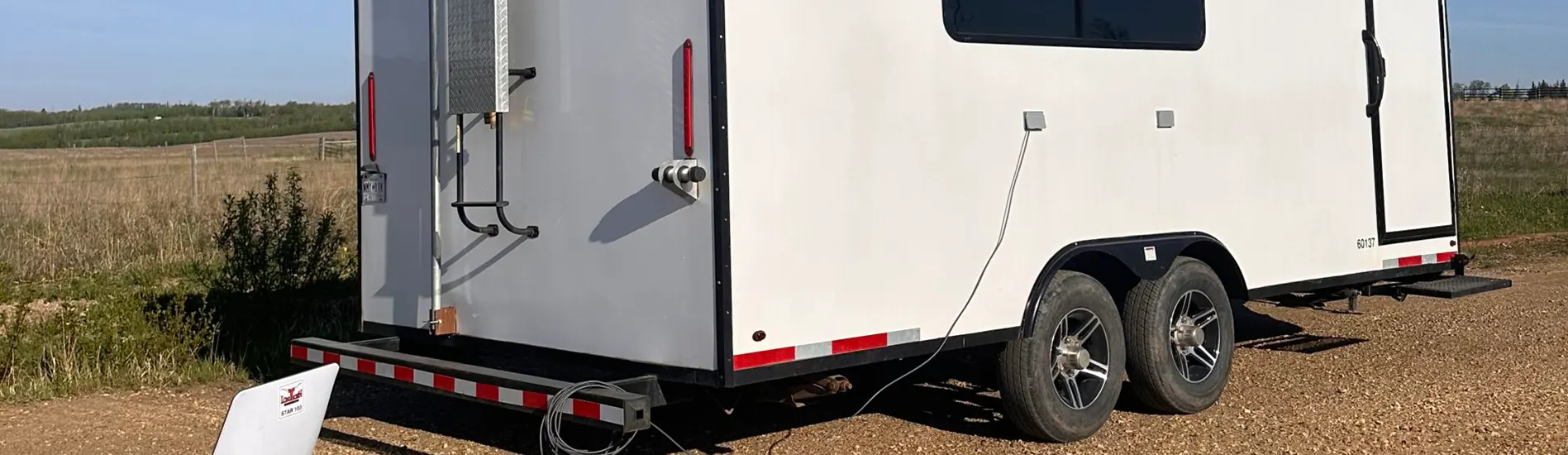
Internet used to be an afterthought on remote oilfield sites. If emails sent eventually and reports uploaded overnight, that was good enough. Not anymore. Today, drilling data is shared live. Safety reporting is digital. Video meetings happen from camp units. And when the Internet drops, productivity drops with it. Using Portable Starlink has changed that conversation in a big way. But for some, there is still some uncertainty and confusion around cost, setup, and what kind of performance you can realistically expect in northern Alberta or northeast B.C.
What It Actually Costs to Run Portable Starlink in the Field
First, let’s talk the hardware involved with running Portable Starlink if you were going to buy outright.
As of 2025, a standard Starlink kit in Canada for oil & gas typically runs between $599 and $799 CAD, depending on the model. The more rugged or high-performance options cost more. For industrial users, the “Flat High Performance” hardware can exceed $3,000 CAD. That is a noticeable jump.
Then there is the monthly service. Residential-style plans usually start around $140 to $170 CAD per month. Priority or business-style plans designed for higher data use can range from $250 to $500+ per month.
For oilfield operations, most companies do not use the basic residential tier. Data demands are heavier. Multiple users are logged in at once. Cloud-based systems are constantly syncing.
So yes, it is more expensive than a home setup. But compared to older satellite contracts that locked companies into multi-year terms with lower speeds, the cost is often competitive.
And here is the key difference: portability. You are not installing a fixed tower. You are not trenching fibre. You can move it lease to lease.
For short-term projects or exploratory work, that flexibility alone justifies the spend for some.
Setup: Easier Than You Think, But Not Plug-and-Play Either
How Portable Starlink is marketed almost makes it seem like you drop a dish on the ground and walk away, and you’re set. That is not quite how it goes on a muddy wellsite in February. Starlink terminals need a clear view of the sky. Trees, tall rigs, flare stacks, and metal buildings can block its signal. Placement matters.
On remote oilfield sites, most setups should include:
- Mounting the dish on a trailer, shack roof, or dedicated pole
- Securing cables to avoid wind damage
- Running power through a stable generator or site power system
- Adding a secondary router or mesh system for larger camps
Fortunately, cold weather is rarely the issue. All Starlink dishes have built-in heaters to melt the snow and ice which means these can work anywhere in Canada. The real problems will come from physical obstructions and poor mounting choices.
Keep in mind that wind can also shift improperly secured units and that leads to connection drops. A stable mount is not optional in northern conditions.
Most crews can get a basic system online within an hour or two. But optimizing placement sometimes takes trial and error. You may need to relocate it once or twice before performance stabilizes.
Despite all this, it is not complicated whatsoever. It just requires patience and a bit of field awareness. Your first time with it may be a bit awkward or it may not be but once you get the hang of Starlink setups, you’ll be able to move a lot quicker.
Portable Starlink Performance Expectations in Remote Western Canada
How well does Starlink actually do on remote oilfield jobsites? Well, as it turns out, pretty impressively.
Download speeds in rural Alberta and B.C. typically range between 50 Mbps and 200 Mbps with Starlink. Upload speeds are usually lower, often between 10 and 25 Mbps. Latency averages around 25 to 50 milliseconds. That is dramatically better than traditional geostationary satellite systems, which often exceeded 600 milliseconds.
What does that mean in practical terms?
Video calls are smooth. Cloud-based project management tools run properly. From your towable office trailers, large drilling reports upload in minutes instead of hours.
That said, performance is not perfectly consistent. During peak evening hours, speeds can dip. Severe weather can cause brief interruptions. Heavy network congestion in certain regions may reduce bandwidth temporarily.
It is still satellite. It is just low-Earth orbit satellite, which is a different category.
For most oilfield sites, the performance is more than adequate. It supports:
- Live data monitoring
- Real-time safety reporting
- Remote troubleshooting with off-site engineers
- Crew communication back home
And that last one matters more than companies sometimes admit. Reliable internet reduces isolation for workers on long rotations. Morale improves when people can FaceTime their kids without freezing screens.
Where Portable Starlink Makes the Most Sense
Not every jobsite needs Portable Starlink. That said, it tends to shine in places where:
- There is no existing infrastructure
- Projects are short-term or mobile
- Crews relocate frequently
- Backup connectivity is required
For some oilfield sites, you may even choose to run Starlink as a secondary failover system, such as if terrestrial networks go down, your satellite Internet kicks in and you’re still connected. That redundancy protects operations.
In recent years, Canada’s energy sector has continued pushing into more remote exploration zones. As operations move farther from established towns, connectivity becomes part of core infrastructure planning. To put this in simple terms, connectivity is no longer optional.
Reliable, High-Speed WiFi for Your Oilfield Construction Job Site is Clean and Easy
Starlink’s portable satellite internet services for an oilfield site is, far and away, worth the rental cost. It provides dependable, high-speed connectivity that can move with the project.
Starlink has the potential to change how crews work, for the better. It certainly changes how data flows. It even changes how companies recruit, because reliable internet makes remote assignments more tolerable.
If your next remote project requires portable, field-ready connectivity solutions and dependable on-site support built for Western Canadian conditions, contact us and connect with Longhorn Oilfield Services to keep your operation connected, efficient, and ready for the realities of the job.